
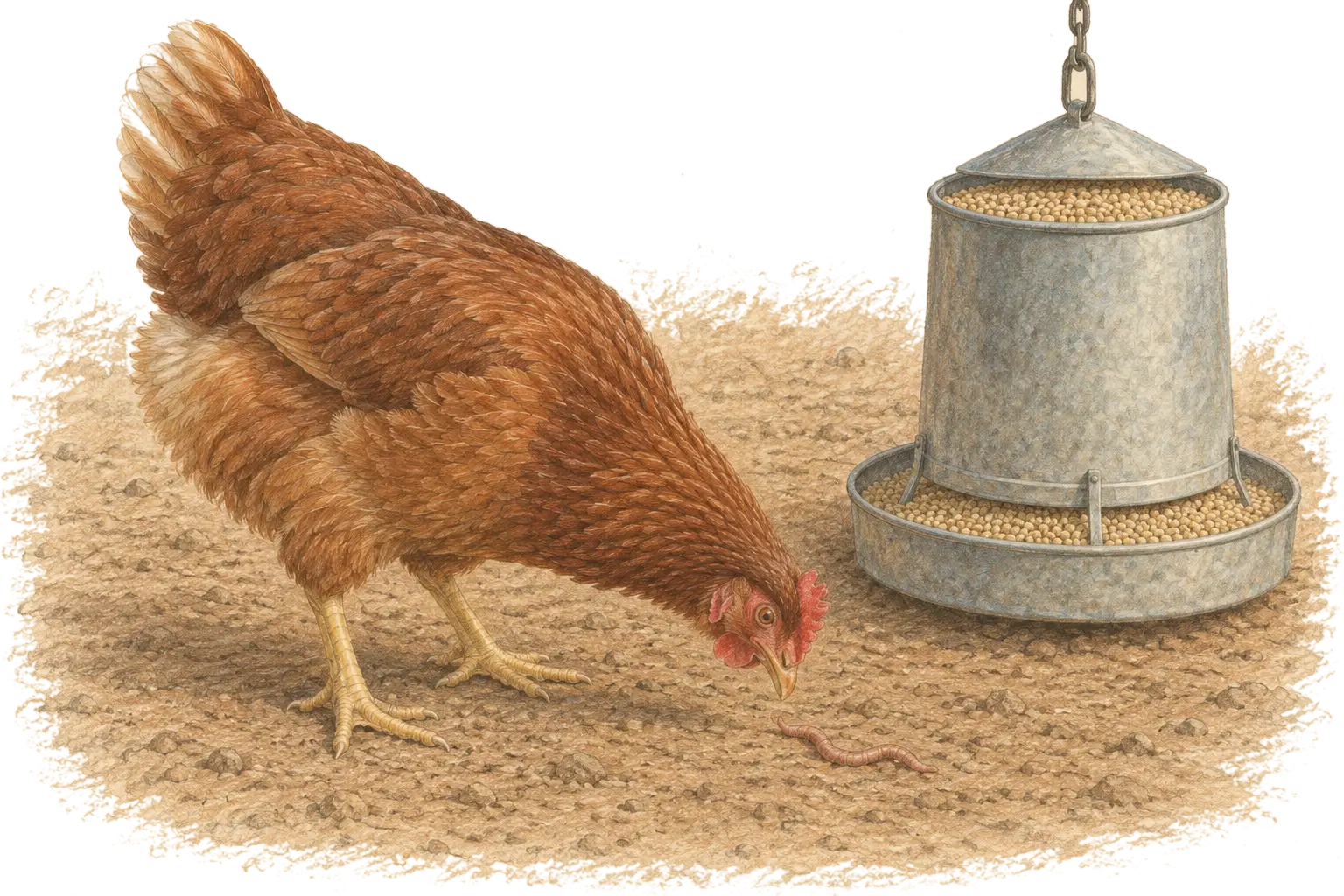
What do chickens eat? Pretty much anything that fits in a beak and can’t outrun them.
That’s why it’s the wrong question. The useful one is what they should eat, and that answer is a lot shorter.
Here it is up front:
- A complete layer feed, making up most of the diet.
- Whatever they find: bugs, worms, seeds and greens.
- Treats and kitchen scraps as a small side, not the main course.
- Oyster shell on the side for hens that are laying.
- Grit, if they eat anything besides the feed.
- Clean water, all day.
The rest of this is the detail. That includes the short list of foods to keep away from them.
What chickens eat when nobody’s feeding them
Turn a chicken loose in a yard and she forages. Seeds, green shoots, beetles, earthworms, grubs, and anything else that makes the mistake of moving.
The phrase researchers at the University of Georgia landed on was generalist predators. If it’s small enough, it’s lunch.
Here’s the catch. Foraging covers only a small part of what a hen actually needs, according to Florida’s guide to raising backyard chickens for eggs.
A lawn is not a balanced diet. It’s a snack bar with an unreliable menu.
A laying hen has the hardest job of all. Making an egg most days takes more protein and far more calcium than a bug hunt turns up.
Layer feed is most of the answer
The bag of feed is the dull part of this article. It’s also the part that matters most.
A complete layer feed is designed to be a hen’s only source of nutrients. That’s the line from Alabama Extension’s guide to feeding the laying hen, and everything else in this article sits on top of it.
Oregon State’s guide on how to feed your laying hens puts the recipe like this:
- Protein: about 16 percent.
- Calcium: 3 to 4 percent, which is what builds the eggshells.
Pellets, crumbles and mash are the same food in different shapes. Pick the one your hens waste least.
How much a hen eats
A laying hen gets through about ¼ lb (100 to 150 g) of feed a day.
You don’t need a kitchen scale. Keep the feeder filled and watch how fast the bin empties, since you’re the one buying the next bag anyway.
Expect that to drop in a heat wave. Digesting makes heat, which is one of the reasons chicken heat stress changes the feeding routine.
When layer feed is the wrong bag
Layer feed is for hens that are laying. The extra calcium that makes a good shell is hard on a bird that isn’t making eggs yet.
Growing birds need only about 1 percent calcium. Layer feed carries 3.5 to 4.
Feed it to chicks or young birds and it can cause growth problems, kidney damage or death. That warning is in Alabama Extension’s guide to nutrition for backyard chicken flocks, and Florida’s guide says the same.
So the bag changes as they grow:
- Chicks get chick starter, a higher-protein feed. The guides put it anywhere from 18 to 24 percent.
- Growing pullets move to a grower or developer feed.
- Layers switch to layer feed at around 18 weeks. Alabama’s rule is no more than two weeks before the first egg.
Medicated chick starter usually contains amprolium, which works against coccidiosis. If your chicks were vaccinated for coccidiosis, skip the medicated feed, because it can undo the vaccine.
Treats and kitchen scraps: the small side dish
This is the part everybody wants to talk about. Chickens make a very persuasive case for sharing your lunch.
Hold the line anyway. Treats, scraps and scratch together should stay around a tenth of what they eat.
The guides land close together. It’s 10 to 15 percent in Oregon State’s guide, and about 10 in Maryland’s guide to feeding the flock.
There’s a handier measure too, also from Oregon State. Give them only what they’ll clean up in about 20 minutes.
The reason is simple. Treats dilute the feed.
A hen full of watermelon has no room left for the stuff that keeps her laying. Alabama Extension says she won’t eat enough of the complete feed to keep producing eggs.
She doesn’t know any of this. She knows watermelon.
Scratch grains are dessert
Scratch is a mix of cracked corn and grains. It sounds like chicken food and it’s sold next to the chicken food, so it’s easy to treat it as a meal.
It isn’t. Most scratch mixes average about 10 percent protein, well short of what a laying hen needs.
If your hens get a complete feed, Oregon State calls scratch unnecessary. Penn State’s guide to raising a small flock of laying chickens goes further and says not to feed it at all.
If you use it, use a small handful. It makes a decent bribe to get everyone into the coop at dusk.
Scraps worth sharing, and one to skip
Vegetable trimmings, leafy greens and a bit of fruit are the usual kitchen treats. Keep them fresh and keep them small.
One yard-waste warning from Alabama Extension: don’t feed lawn clippings if pesticides went on the grass recently.
Foods to keep away from chickens
Start with the one every guide agrees on. Never feed moldy food or moldy feed.
Molds make toxins that can seriously harm poultry. Alabama and Maine both say so without any wiggle room.
If the feed smells musty, has clumped, or has gone green in the bottom of the bin, it goes in the trash.
After that, there’s a longer list of foods you should never feed chickens from the extension office in Holmes County, Florida. Beyond mold, it names:
- avocado
- chocolate
- raw or dry beans
- green potato peels
- salty food
- onions
- alcohol
- apple seeds and fruit pits
- coffee and anything else with caffeine
In fairness, the evidence isn’t equally strong for every item. Mold is backed everywhere you look.
Several of the others come mostly from that one list. For onions, the concern is large amounts, not a stray sliver in the scraps.
None of them are worth testing on your hens, though. They’d happily eat every one, because chickens are enthusiastic rather than discerning.
Oyster shell and grit, which are not the same thing
These two sit next to each other at the feed store. They do completely different jobs.
Oyster shell is calcium
Oyster shell is extra calcium for laying hens. Oregon State says to offer it free-choice, in its own feeder, not mixed into the feed.
A good layer feed already carries calcium, so some hens barely touch the shell. Offering it separately lets the ones who need more help themselves.
Chicks and non-laying birds don’t need it.
Grit is teeth
Chickens have no teeth. They grind food in the gizzard, a muscular pouch that works with small hard stones.
That’s grit: insoluble granite grit, sized for chickens.
Whether they need it depends on the diet:
- Only commercial feed: no grit needed. Alabama Extension points out the feed is already ground.
- Scratch, scraps or whole grains: offer grit. Oregon State says to provide it whenever you feed scratch.
- Free-range birds: they usually pick up their own from the ground, but a dish of it doesn’t hurt.
What changes when they molt
Once a year, usually in the fall, hens drop their feathers and grow new ones. They stop laying while they do it, and they look terrible.
Feathers are mostly protein, so the diet shifts. A Texas A&M veterinarian writing on hen molting says a 20 percent protein diet is usually adequate, and to check with your vet on your own flock.
The guides don’t agree on exactly how to make the switch. Alabama suggests swapping layer feed for developer feed during the molt, with calcium on the side.
When the experts disagree on the details, your vet or county extension office can tell you what suits your birds.
Questions people ask about what chickens eat
Do free-range chickens still need feed? Yes. Foraging covers only a small share of what a hen needs, and a laying hen needs the calcium and protein a yard can’t supply.
The bugs are a bonus. The feeder does the real work.
Can baby chicks eat layer feed? No. The calcium in layer feed can damage a growing bird’s kidneys.
Chicks get starter, pullets get grower, and layer feed waits until about 18 weeks.
Do chickens need grit if they only eat pellets? Not if pellets or crumbles are all they eat, because commercial feed is already ground. Once scratch, scraps or foraging come into it, offer grit.
How much scratch can I give my chickens? A small handful. Treats and scratch together should stay around 10 percent of the diet.
A good test is whether they finish it in about 20 minutes. If there’s scratch still lying around at bedtime, that was too much.
Is it legal to feed kitchen scraps to chickens? The federal garbage-feeding rules we found are written for pigs, not backyard chickens. That’s the USDA’s garbage feeding fact sheet for swine growers.
Other places are stricter. The European Union has banned feeding kitchen scraps to chickens since 2001, pet chickens included, with raw vegetables from the garden the exception.
If you’re unsure what applies where you live, your state department of agriculture can tell you.
Can chickens eat avocado? Keep it away from them. Avocado contains persin, and it’s on the extension list of foods never to feed chickens.
What do chickens eat in winter? The same layer feed. Laying slows down as the days get shorter, but the feed bill doesn’t take the winter off.
Where to go from here
If you take one thing away, make it this. Feed does the real work, and treats are the small print.
Water matters even more than feed, and it’s where more trouble starts. Read how much water chickens drink next.
If you’re still deciding whether to keep chickens at all, Backyard Chickens 101 covers the feed bill along with everything else.
And for the long game, a steady diet is part of how long chickens live.
Then go buy a proper bag of layer feed. The hens will still beg for your sandwich. Stay strong.
Where this came from
- How to feed your laying hens (PNW 477)Oregon State University Extension Service
- Backyard & Small Poultry Flock Management Series: Feeding the Laying HenAlabama Cooperative Extension System
- Nutrition for Backyard Chicken FlocksAlabama Cooperative Extension System
- Raising Backyard Chickens for Eggs (AN239)University of Florida IFAS Extension
- Feeding the FlockUniversity of Maryland Extension
- Successfully Raising a Small Flock of Laying ChickensPenn State Extension
- Nutrition for Backyard Chicken Flocks in Maine (Bulletin #2222)University of Maine Cooperative Extension
- CAES researchers decode chicken diets to boost sustainability on integrated farmsUniversity of Georgia College of Agricultural and Environmental Sciences
- 10 Foods You Should Never Feed ChickensUF/IFAS Extension Holmes County
- Hen Molting: What To Egg-spectTexas A&M School of Veterinary Medicine & Biomedical Sciences
- What Swine Growers Need to Know about Garbage FeedingUSDA APHIS
- Biosecurity Strategies for Backyard Poultry: A Controlled Way for Safe Food ProductionFood Control and Biosecurity (Elsevier, 2018), via PubMed Central
Claims on this page last checked against source in September 2026.