
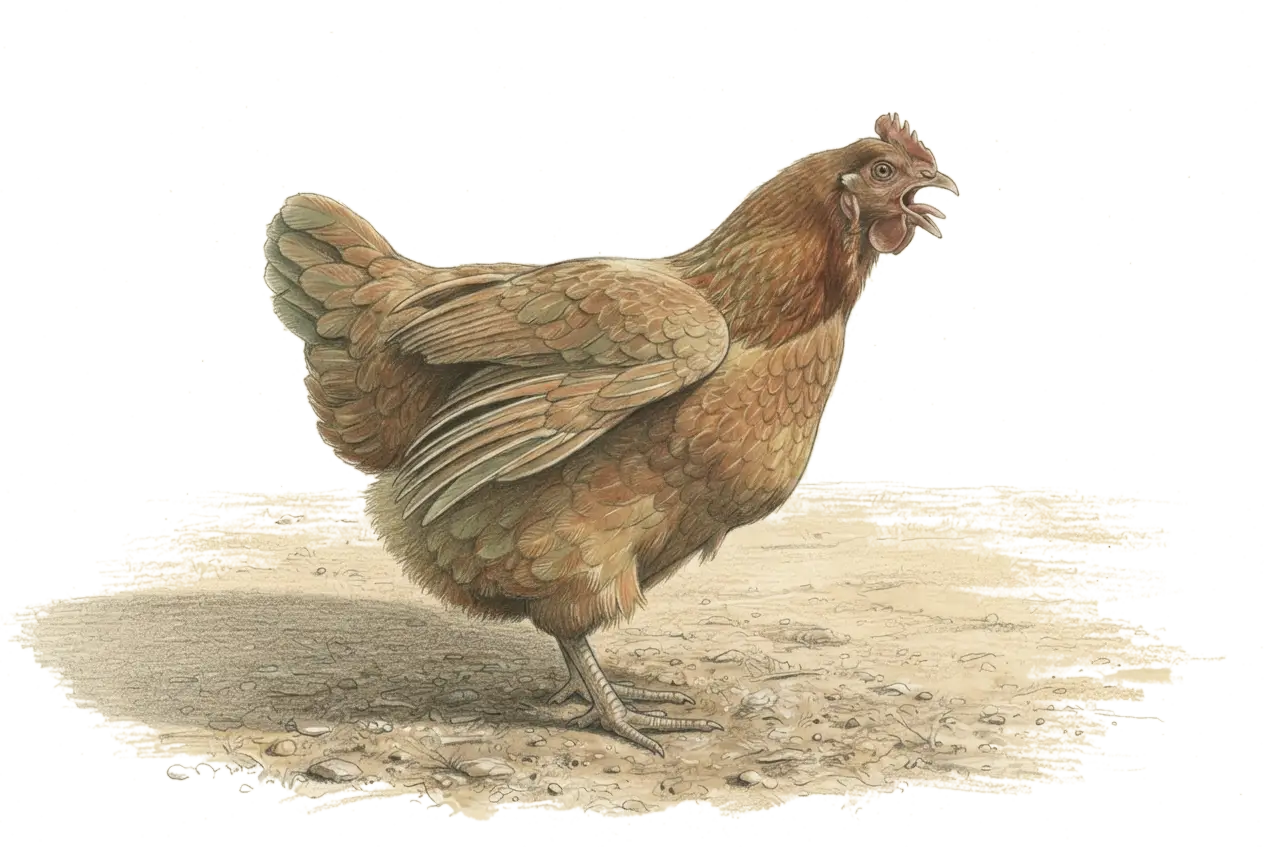
It’s three in the afternoon, it’s hot enough to fry an egg on the coop roof (don’t, she’s watching), and one of your hens is standing in the shade with her beak wide open and her wings held out from her sides like she’s airing her armpits after a long flight.
Is she dying? Or is she just being a chicken about it?
Nine times out of ten, she’s fine. That’s a hot chicken doing the only thing a hot chicken can do, which is stand there looking personally offended by the weather. But there’s a version of that exact picture that’s a real emergency, and from across the yard the two look the same. So here’s how to tell them apart, what to do in the next five minutes if it’s the bad one, and how to set the yard up so you stop having this argument with yourself every July.
Why chickens are so bad at heat
Three reasons, and they stack up against her like a bad hand of cards.
She can’t sweat. Nobody gave chickens sweat glands. Whoever designed them was clearly busy with the feet and the egg thing and just ran out of time.
She’s already running hot. A chicken’s normal body temperature is around 105°F (41°C). She wakes up every morning at a temperature that would have you in the emergency room asking about your affairs.
She’s wearing a down jacket. In July. No zipper. Feathers are wonderful insulation, which is lovely in January and a cruel joke in August.
So all she’s got is panting. Hot air out, water out with it, that’s the whole cooling system. And look, a dog pants and looks like it’s having the best day of its life. A hen pants and looks like she’s drafting a strongly worded letter to whoever’s in charge of the sun. In her defense, panting costs her water, and it starts earlier than you’d guess.
The comfy zone for a chicken is about 60°F (16°C) to 75°F (24°C). Above 80°F (27°C) she’s feeling it, and by 85°F (29°C) it’s obvious. Humidity makes the whole thing worse, because panting only works if the air’s got room for more moisture, and on a muggy day it doesn’t. A sticky 85°F (29°C) is a nastier afternoon for a hen than a bone-dry 95°F (35°C). She knows this. She’d like you to know it too.
Hot versus in trouble
This is the bit to actually read, because the early signs and the scary signs are the same picture with the color drained out.
| What you see | What it means | What to do |
|---|---|---|
| Light panting, wings held a bit out, hunting for shade, glaring at you | She’s hot. She’s handling it | Shade, cool water, leave her to her sulk |
| Heavy panting, wattles slapping together under her chin, crouching or lying down | She’s struggling | Shade and cool water right now. Don’t take your eyes off her |
| All that plus a pale comb and wattles, limp, floppy, not reacting to you | Heat exhaustion. This is the emergency | Cool her immediately. Read the box below |
The pale comb is the one to tattoo on the inside of your eyelids. A hot hen with a red comb is a hot hen. A hot hen with a comb going pale and a look on her face like she’s made peace with the universe needs you in the next few minutes, not after you’ve finished hanging the laundry.
Who gets hit hardest
Not every bird in the flock is running the same race, and the ones in trouble are, unfairly, usually your favorites.
- The big girls. More body, more heat, less surface to lose it through. Your enormous Orpington who looks like a sofa cushion with opinions is the first one to watch.
- The fluffy ones. All that soft feathering holds heat against the skin. Gorgeous in October. A walking comforter in August.
- Anyone laying. Making an egg a day is work, and the laying girls tip into trouble earlier than the ones who’ve clocked off for the season.
- Meat birds. Built for speed, not weather, with the athletic reserves of a beanbag.
What heat does to the eggs
You’ll notice this in the kitchen before you notice it in the yard.
Fewer eggs. Smaller eggs. Shells you could read the paper through. It starts creeping in around 80°F (27°C) and gets serious from 85°F (29°C) up.
The thin shells have an interesting reason, and I’ll give you the plain English version because the science one has more letters than a pharmacy. When she pants, she blows off carbon dioxide. Losing carbon dioxide shifts the chemistry of her blood, and one of the side effects is that less calcium is available for building shell. So the shell comes out thin not because she’s short of calcium, but because the calcium she’s got can’t get to the job site. She’s also eating less, which doesn’t help. Nobody eats much at 95°F (35°C), including her.
Two things you’ll see that are normal, not alarming:
- Watery droppings. She’s drinking two to four times what she normally does. What goes in must come out, and it comes out enthusiastically.
- A slow comeback. If the heat knocked her laying down, it can be a month before she’s back to normal. She’s not broken. She’s sulking. After the week she’s had, fair enough.
Stopping it before it starts
None of this is clever. All of it works.
Shade, and shade over the water. A waterer in the sun is bathwater by two o’clock, and chickens drink less from warm water. There’s more on that in how much water chickens drink, but the short version is: warm water, thirsty birds, nobody drinking, and everybody looking at you like it’s your fault. Which it is.
More waterers than you think you need. Every flock has one hen who guards the waterer like she’s working the door at a nightclub and your name isn’t on the list. On a hot day the bird at the bottom of the pecking order can’t afford to wait her turn. Two waterers. She can’t guard both. She’ll try.
Cool the water. A few ice cubes or a frozen water bottle in the fount. Cool, not freezing. A frozen bottle in the nest box too, for the hen who insists on sitting in the hottest corner of the building because that’s where the eggs go and rules are rules.
Get the air moving. Open it up, put a fan in, a mister if you’ve got one. A closed-up coop on a summer afternoon is an oven with a roof and a roosting bar.
Wet the ground. A hose on the dirt around the run, or a shallow pan they can stand in. They lose heat through their feet, and a hen standing in an inch of cool water on a hot day looks every bit as smug as you’d expect. Fair warning: the first time you turn the hose on, the flock will react as though you’ve declared war. Give them a day. By day three they’ll be lining up.
Feed early and late. Digesting makes heat. Breakfast at dawn, dinner at dusk, and nothing much in the middle. Your hens will regard this as theft. Do it anyway.
Leave them alone at three o’clock. Don’t move birds, clean the coop, or introduce the new pullet in the heat of the day. A chicken being chased around a run at 95°F (35°C) is making heat she can’t shed, and she will remember whose idea it was. She’s got a long memory for grudges and none at all for where she laid yesterday.
Let the night do its job. This one’s underrated. A hen who got too hot today can take most of the night to shed it, and if the night stays warm she doesn’t manage it before tomorrow starts. That’s why day three of a heat wave is worse than day one even when the thermometer says the same thing. Open the coop up at night. Get air through it. She’s carrying yesterday’s heat into today like a bad mood.
Electrolytes, briefly. They help replace what she loses in a heat wave, for a day or three. Nobody anywhere says leave them in all summer. There’s a whole piece on electrolytes for chickens about when they help and when they’re just expensive salty water.
The short version
Hot is normal. Panting is normal. Wings out is normal. Glaring at you is normal, and also year-round.
A comb going pale, a hen lying flat, a bird who doesn’t get up when you walk toward her: that’s the emergency, and the answer is cool water up to the neck, right now, before anything else.
Everything else is shade, cool water in more than one place, air through the coop, and not bothering them in the afternoon. Chickens are surprisingly tough. They’ll survive a fox, a hawk, a snowstorm, and each other. Heat’s the one thing they’re not built for, and it’s the one where five minutes of your attention makes the whole difference.
Where this came from
- Hot Weather Management of PoultryPenn State Extension
- Summer Flock Care: Keeping Your Birds Cool and ComfortablePenn State Extension
- Preventing Heat Stress in PoultryUniversity of Minnesota Extension
- Managing Backyard Chickens During Periods of Extreme Summer TemperatureExtension Foundation, Small and Backyard Poultry
- Protect Backyard Chickens, Livestock From Extreme HeatMississippi State University Extension
- Summer Heat Stress Is Detrimental to Broiler Chickens (D260)University of Tennessee Institute of Agriculture
- Sickness Behavior in Chickens (FS-1178)University of Maryland Extension
- Big Birds, Hot Weather, and Maximum Air MovementAuburn University, Poultry Engineering, Economics and Management Newsletter
- Heat Stress in Poultry: The Role of Nutritional Supplements in Alleviating Heat Stress and Enhancing Gut Health in PoultryFrontiers in Veterinary Science
Claims on this page last checked against source in September 2026.