
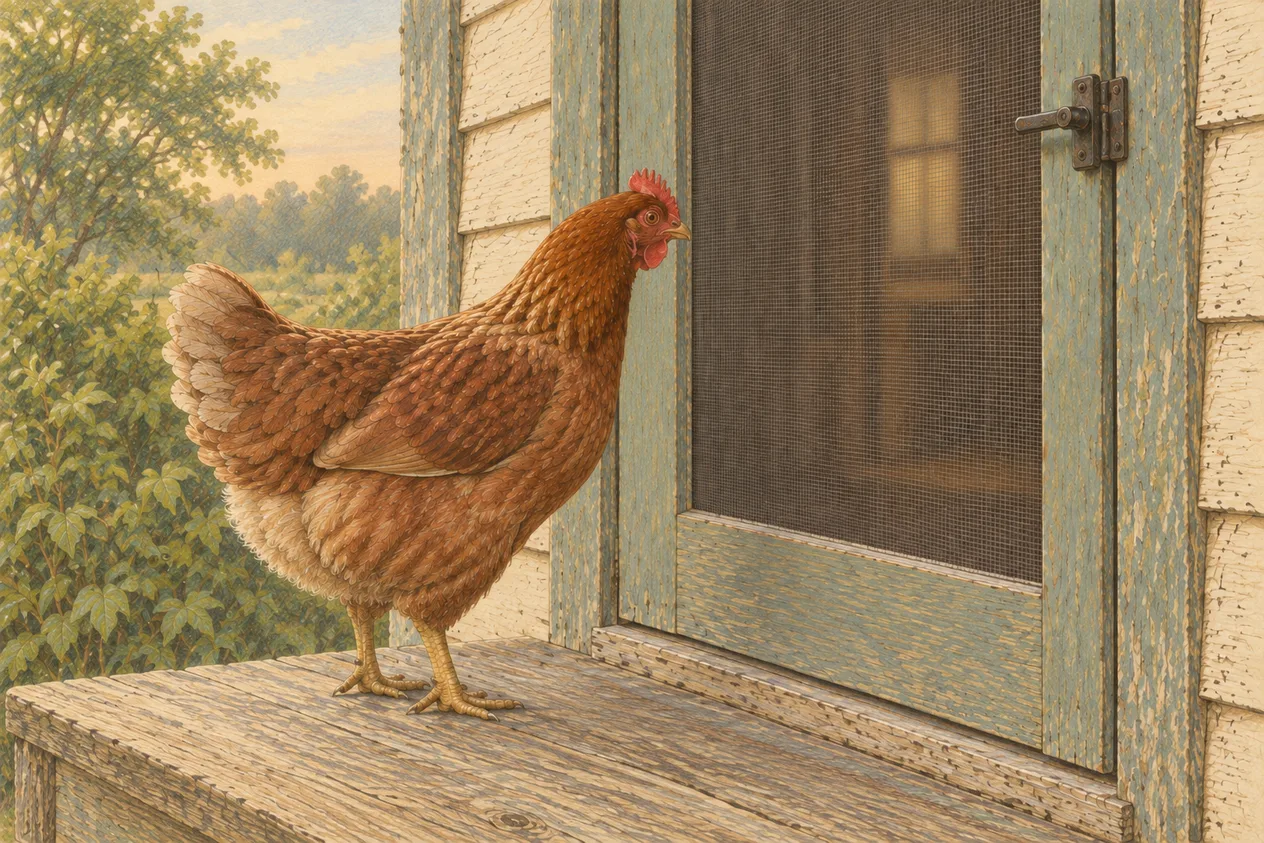
Backyard chickens get sold to you as eggs. Fresh ones, every morning, from a hen with a name.
That part’s true. What the picture leaves out is everything standing behind the egg.
- A town ordinance.
- A coop a raccoon can’t open.
- A waterer that needs scrubbing.
- A germ you can’t see.
- A bird who’ll still be in your yard long after she’s stopped laying.
None of that is a reason not to do it. It’s just the fine print.
Read it before the chicks arrive, not after. Here’s what you’re actually signing up for, checked against the people whose job it is to know.
First, find out if you’re even allowed
Everybody skips this step. It’s boring.
It’s also the one that can end the whole project with a single letter from the city.
Lots of towns cap how many hens you can keep. Some say how far the coop has to sit from the neighbors.
Some ban roosters. Some ban chickens altogether, and they don’t care how nice your coop is.
Virginia Tech’s ten things to know before you get chickens has this at number one. So does Georgia’s backyard flock guide.
So before you buy a single thing, look up your town’s poultry ordinance. Then check the HOA rules, if you have an HOA.
Then go talk to the people over the fence. Bring a promise of eggs.
A neighbor who heard about the hens from you is one kind of neighbor. One who found out at six in the morning is another.
You don’t need a rooster (your neighbors will be relieved)
This surprises a lot of people. Hens lay eggs whether or not there’s a rooster anywhere near them.
A rooster is how you get chicks. That’s his whole job.
He also brings noise, starting well before you’d like to be awake. And sometimes a firm belief that your ankles are a threat to national security.
If your town bans roosters, that’s why.
Hens aren’t silent either. A lot of them announce every egg as if nobody in history has ever laid one before.
But it’s short, and it’s in daylight. It’s a long way from a crow at dawn.
The eggs come on her schedule, not yours
Chicks don’t lay. A pullet lays her first egg at around 18 to 22 weeks old, depending on breed and season.
So chicks bought in spring turn into eggs around late summer. Until then you’re running a small, noisy, egg-free petting zoo.
Once she starts, here’s the curve, from the University of Florida’s guide to egg production in backyard flocks:
- Six to eight weeks in: the flock peaks, about 90 percent laying on any given day.
- After a year of laying: down to about 65 percent.
- After two or three years: a lot of hens drop off sharply.
She also wants about 14 hours of daylight to keep going. That’s why winter goes quiet.
Once a year she stops altogether to molt. She looks terrible for a few weeks, then grows a new set of feathers.
Then there’s the long end. A hen lives eight to ten years and is usually done laying by about seven.
So you get a brilliant layer for two years and a fair one for a couple more. After that, a pet who lives in your yard and has opinions about you.
There’s a whole piece on how long chickens live. Read it before you name anyone.
They will not save you money
Everybody hopes this one is wrong. It isn’t.
When egg prices went through the roof, Oregon State’s extension service wrote a piece for people thinking about chickens because of the cost of eggs. The verdict was short: not a big money saver.
You pay for the coop, the fencing, the feeder, the waterer and the bedding. Then you pay for feed, forever.
The feed bill doesn’t pause when nobody’s laying. The hens eat through those months with a clear conscience.
Keep chickens because you want chickens. Fresher eggs, a yard that gets debugged for free, and a better daily show than most of what’s on television.
If you’re doing it to beat the grocery store, the grocery store wins.
What they need from you, every single day
Chickens aren’t a lot of work. They’re a small amount of work that never takes a day off.
Space, inside and out
The Small and Backyard Poultry space guide says at least 3 to 4 square feet (0.28 to 0.37 m²) per hen in the coop. And 10 square feet (0.9 m²) per hen in the run.
Those are minimums, not targets. Crowded hens pick fights and pick up diseases, roughly in that order.
Add one nest box for every four or five hens, about 12 in (30.5 cm) square, half filled with straw. You’ll build more than that.
They’ll all line up for the same one anyway. There’ll be a fight about it.
The coop’s other job is keeping things out. Raccoons, foxes, hawks, the neighbor’s dog.
A coop that shuts tight at night is the biggest thing between your hens and a very short life. The extension guides call it basic biosecurity for a reason.
Feed and water
A laying hen gets through about ¼ lb (100 to 150 g) of feed a day. It needs to be a proper layer feed, not a bowl of scratch and kitchen scraps.
Alabama Extension’s guide to feeding the laying hen has the warning worth taping to the fridge. Fill her up on treats and she won’t eat enough of the real stuff to keep laying.
She will not make this connection herself. She’ll just stop laying and look at you.
Water matters more than feed. It’s also where most of the trouble lives.
Twenty hens can drink about 1 gallon (3.8 L) a day in cool weather. In heat, a great deal more.
There’s a whole article on how much water chickens drink. Start there.
The chore list
The daily list, straight from Georgia’s guide, is short:
- Check the nests twice a day.
- Scrub the drinkers daily.
- Clean the feeders whenever they’re dirty.
- Swap out wet litter for fresh.
Add shutting the coop at dusk and opening it in the morning. Every day.
That includes the day you have the flu and the day it’s sideways rain.
Before you book your first trip, find a neighbor who has actually agreed to do all of it. The chickens will not accept “I was in Florida” as an excuse.
The part nobody puts on the brochure: germs
Here’s the one that catches families out. Poultry can look perfectly healthy and still carry germs that make people sick.
Salmonella is the famous one. It travels on hands, on shoes, and on anything the birds have walked across, which is everything.
The CDC’s rules for backyard poultry are simple. Every one of them gets broken because the chicks are so cute.
- Wash your hands with soap and running water after touching the birds or anything in their area.
- Don’t kiss or snuggle them. You will want to. Don’t.
- Keep them out of the house, especially anywhere food is prepared.
- Kids under 5 don’t handle chicks or other poultry. Older kids get supervised at the sink afterward.
- Keep a pair of chicken-yard shoes that live outside.
- Cook eggs until the yolk and white are both firm, and egg dishes to 160°F (71°C).
Manure counts too. It carries bacteria, so it needs a plan, not a heap by the back fence that everybody agrees not to mention.
None of this makes chickens dangerous. It makes them farm animals, and farm-animal habits come with them.
Bird flu, and who to call
Bird flu has been turning up in American flocks, backyard ones included. It’s a reportable disease, so it’s your business from the moment you own a hen.
The USDA’s advice on protecting your flock from avian influenza comes down to four habits:
- Clean your gear and boots.
- Keep a dedicated pair for the chicken area.
- Keep wild birds away with a covered run or netting.
- Learn the warning signs.
Find the vet before you need one
Almost nobody does this until it’s too late. Plenty of vets don’t see chickens at all.
The University of Wisconsin’s extension office says finding a veterinarian for your chickens is something a lot of small-flock owners struggle with. So make the connection while everyone’s healthy.
Ask your county extension office. Ask at the feed store, ask the local chicken group, and call a few clinics.
There’s a practical reason to do it early. Most vets need an existing relationship with you before they can write a prescription.
Finding that out at nine on a Sunday night, with a sick hen in a box on the porch, is the hard way.
Why people do it anyway
After all that, you might wonder why anyone bothers. Here’s the honest answer.
Chickens are ridiculous, in the best way. They have opinions, a social ladder, long-running feuds, favorites, and a deep conviction that whatever you’re holding is food.
Years ago we kept chickens on a farm in Gingin, Western Australia, when my boys were small, and they loved having them around. The hens were theirs as much as anyone’s.
I don’t keep chickens now, and I’m not going to pretend otherwise. But I’d put that at the top of the list of reasons, well ahead of the eggs.
The last item on Virginia Tech’s list is the one I’d underline: go by science-based information, not folklore. There’s a lot of folklore, and most of this site exists because of it.
The questions everybody asks
How many backyard chickens should I start with? Fewer than you think. Your ordinance may cap it anyway.
Chickens are social, so one on her own is a lonely bird. A small group is plenty for a first flock.
Adding more later is easy. Going the other way is not.
Do backyard chickens smell? A clean coop with dry bedding barely smells. A wet, crowded one smells like a crime scene.
Fresh litter, room per bird, and a waterer that isn’t leaking into the bedding fix most of it.
Can I keep chickens inside the house? The CDC says no, especially anywhere food is prepared, served or stored. That includes the chick in a box on the kitchen counter, which is exactly where everyone wants to put her.
How long until I get eggs? Around 18 to 22 weeks from hatch, depending on breed and season. If you’d rather skip the wait, buy started pullets instead of chicks.
What happens when they stop laying? Every keeper has to decide this. It’s easier to decide early.
The extension guides put planning for very sick or injured birds, humane euthanasia included, on the list of things to sort out before you start. Plenty of people just keep their retired hens as pets.
Either way, decide in year one, not year five.
Are backyard chickens a lot of work? Not a lot, but it’s daily. Food, water, eggs, a quick look at everyone, shut the door at night.
The work is small. Never missing a day is the real commitment.
Where to go from here
If you’ve read all that and you still want chickens, good. That’s the right order to do it in.
Start with the boring stuff that keeps them alive. Water causes more trouble than anything else.
So read how much water chickens drink first. Then the signs of dehydration in chickens, then chicken heat stress for when it gets hot.
Or head to the water and hydration section and work through the lot.
Then check your ordinance, talk to the neighbors, and find that vet. The hens can wait a week.
They’ll act like they’ve been waiting their entire lives. But they can.
Where this came from
- Ten Things to Know Before You Get Chickens (APSC-172)Virginia Cooperative Extension, Virginia Tech
- Management Guide for the Backyard Flock (C969)University of Georgia Cooperative Extension
- Factors Affecting Egg Production in Backyard Chicken Flocks (PS029)University of Florida IFAS Extension
- Space Allowances in Housing for Small and Backyard Poultry FlocksSmall and Backyard Poultry, eXtension
- Backyard & Small Poultry Flock Management Series: Feeding the Laying HenAlabama Cooperative Extension System
- Thinking about backyard chickens? Know the costs and care firstOregon State University Extension Service
- Backyard PoultryCenters for Disease Control and Prevention
- How to Protect Your Flock from Avian InfluenzaUSDA APHIS, Defend the Flock
- Defend the Flock: Signs of IllnessUSDA APHIS
- Finding a Veterinarian for your ChickensUniversity of Wisconsin-Madison Division of Extension
Claims on this page last checked against source in September 2026.