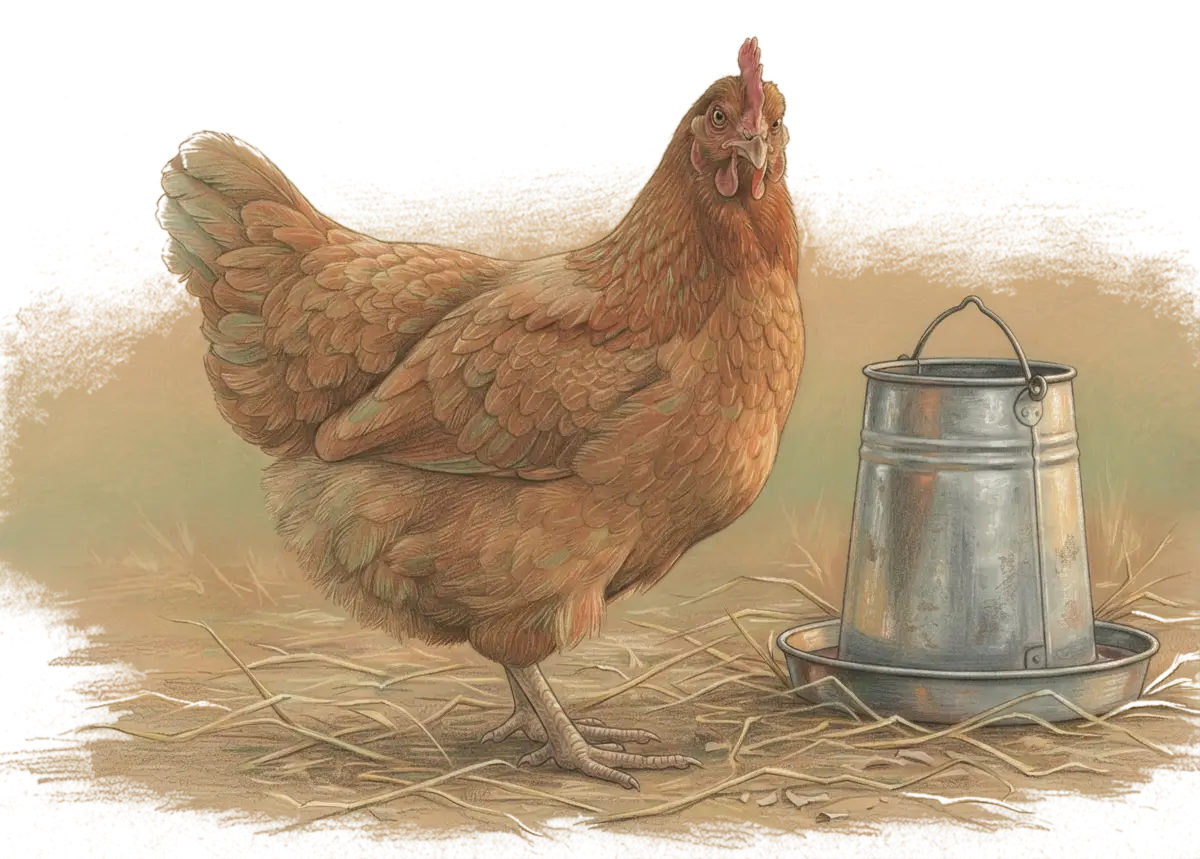
Somebody asks this expecting a number, and the number exists, but on its own it is close to useless. A hen in mild weather and the same hen on a 100°F (38°C) afternoon are two different animals with two different problems.
So here is the number first, and then the part that actually matters.
The short answer
Roughly 1 cup (237 mL) a day per adult hen in comfortable weather. In heat that can double or triple.
That figure comes from working backwards out of the extension guidance rather than from a stopwatch and a measuring jug. Alabama Extension puts it as one gallon a day being enough for about sixteen laying hens, which is a cup each. Penn State approaches it from the other end and says provide at least 5 gallons (18.9 L) a day for every hundred birds — a provision floor rather than a measurement, and a little lower per bird.
For six hens, then, you are looking at somewhere near 1.5 quarts (1.4 L) on a mild day, and you should be ready for that to double or better in a hot week. That is the figure worth carrying in your head, because it tells you whether the waterer you own is big enough to leave for a day. Very often it isn’t.
Why “it depends” is the honest answer
Water intake moves with about five things at once, which is why every source quotes a different number and most of them are sort of right.
| What changes | Which way it pushes intake | Rough size of the effect |
|---|---|---|
| Air temperature | Up, steeply, once panting starts | The big one — can double or triple it |
| Laying or not | Up while in lay | An egg is 65–70% water |
| Feed type | Up on dry pellets and mash | Moderate |
| Bird size | Up with body weight | Moderate |
| Water temperature | Down if the water is warm | Larger than people expect |
That last row is the one most people miss. Chickens drink less when the water is warm, and a dark waterer sitting in afternoon sun gets warm fast. You can do everything right on volume and still have birds drinking less than they need because the water has stopped being appealing.
The feed ratio, which is more useful than the cup
Here is the rule of thumb that survives contact with reality better than a fixed volume. Alabama Extension puts it plainly: under normal circumstances chickens drink about twice as much water as they eat feed, by weight. Under heat load that ratio climbs.
This is more useful because you probably already know your feed consumption. If your flock gets through 1.5 lb (0.68 kg) of layer pellets a day, you can reason your way to the water figure without measuring anything.
What heat actually does
Chickens don’t sweat. Penn State describes the two routes they do have: shedding heat from the wattles, shanks and the unfeathered skin under the wings, and — once it gets warm enough — panting, which works by evaporating water from the lining of the respiratory tract.
That second route is the one that costs water, and it starts earlier than most people expect. Heat stress begins above 80°F (27°C), panting starts around that same mark, and by 85°F (29°C) it is obvious. So the point where water stops being a background chore and becomes the thing you are managing is well before the day feels dangerous to you.
Practical consequences, in the order they matter:
- More water points, not one bigger one. A single waterer is a single point of failure, and a bird at the bottom of the pecking order may not get near it. Penn State suggests 1 in (2.5 cm) of water space per bird as the access figure.
- Shade over the water, not just over the birds. Keeps it drinkable.
- Check it in the afternoon, not just the morning. Morning is when the problem isn’t there yet.
Chicks are a different problem
Chicks drink far less in absolute terms and have far less margin. A brooder runs warm by design, which means the water warms too, and a chick that goes off water gets into trouble in hours rather than days.
The practical difference is checking frequency rather than volume. Twice a day is fine for adult birds in mild weather. A brooder wants eyes on it more often than that.
What to actually do
Nothing here needs equipment you don’t have.
- Work out your flock’s mild-weather figure once — roughly 1 cup (237 mL) per adult bird — and check your waterer holds comfortably more than double it.
- Put the waterer in shade, and move it when the shade moves.
- In a hot spell, check it in the afternoon as well as the morning.
- Add a second water point before you think you need one.
That is most of it. Water is the least interesting thing in chicken keeping and the one that causes the most avoidable trouble, which is a fairly typical arrangement.
Where this came from
- Management Requirements for Laying FlocksPenn State Extension
- Backyard & Small Poultry Flock Management Series: Feeding the Laying HenAlabama Cooperative Extension System
- Hot Weather Management of PoultryPenn State Extension
- Managing Backyard Chickens During Extreme Summer TemperaturesExtension Foundation, Small and Backyard Poultry
Claims on this page last checked against source in September 2026.