
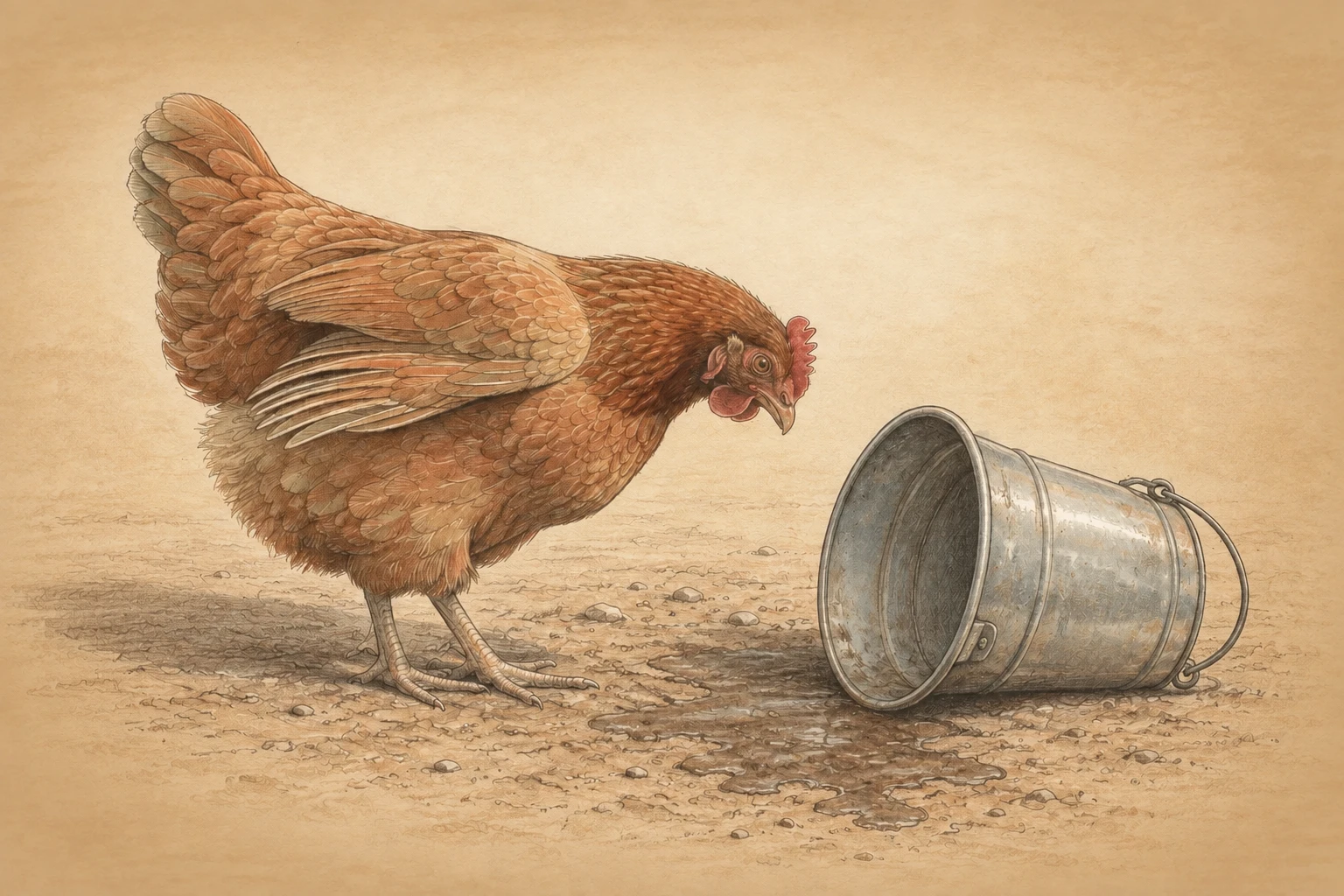
Here’s an unfair thing about chickens. A dog that feels rough will lie on your feet and sigh at you until you notice. A chicken that feels rough will stand slightly apart from the others, look completely normal to anyone not paying attention, and quietly get worse. They’re prey animals. Looking weak gets you eaten. So a chicken hides being sick like it’s a personal failing, and by the time she looks thirsty, she’s been thirsty a while.
So this is the article for the afternoon you look out the window and something’s off. Maybe the waterer’s still full at five o’clock and that has never once happened. Maybe one hen’s standing in the corner looking like a slightly deflated version of herself. Here’s what a dry chicken actually looks like, the seven reasons she might be boycotting the water, and how to get some into her.
How fast this goes wrong
Faster than you’d like, and for chicks it’s not even close.
The rule for laying hens is twelve hours. Go longer than that without water and the eggs stop, sometimes for a good while. But that’s the egg number. The health number’s worse, because a chicken without water stops eating too, and now you’ve got two problems wearing one chicken.
Chicks have basically no margin. A brand new chick can run on its leftover yolk for a couple of days, which sounds generous until you realize that’s for a chick straight out of the shell, not the two-week-old who’s been standing in a 95°F (35°C) brooder since breakfast with an empty dish. For a chick, trouble shows up in hours.
What a dehydrated chicken looks like
There’s no thermometer for this. You’re reading the bird.
| Look at | Normal | Dried out |
|---|---|---|
| The comb | Plump, firm, a bit rubbery | Shrunken, dry, flat |
| The eyes | Bright, round, following you (with suspicion) | Dull, sunken, half shut |
| Where she is | In the middle of everything, minding everyone’s business | Off on her own, standing still, not interested |
| Her shape | A chicken | A chicken that’s been left out overnight and gone a bit flat |
| Droppings | Regular and plentiful | Fewer, drier, or none |
The comb’s your best instrument. Pick her up and look at it properly. A healthy comb is plump and springy. A dehydrated comb looks like it’s been left out in the sun, because it has.
Sunken eyes and a dry, sticky mouth are what the bird vets go by. The skin-pinch test people do on dogs doesn’t really work on chickens, because there’s no loose skin to pinch. Don’t bother pinching your chicken. She’s got enough going on.
For chicks, watch for pasty vent. Without enough water a chick can’t digest properly, the droppings turn to paste, the paste sticks to the fluff around the back end, and then the whole thing seals over. That one can kill a chick. Soak it off gently with warm water, and then have a hard look at the water situation in the brooder, because that’s where the problem started.
Why she won’t drink: the detective bit
Chickens aren’t stupid about water. They know exactly what they want. It’s just that what they want and what you’ve provided are often two different things, and a chicken would rather go without than compromise. She’s a lot like your grandmother that way.
The water’s warm. This is the big one and it’s the one everybody misses. Chickens will drink water that’s nearly freezing, no problem. But water that’s up near their own body temperature? They’d rather be thirsty. Somebody measured this. She would rather go without. And that plastic waterer sitting in the afternoon sun gets there faster than you’d think. Meanwhile she’s over by the downspout drinking out of a puddle with a leaf in it, because the puddle’s in the shade and the puddle’s cold. Nobody said they were sensible. They’re just right about the temperature.
The water’s disgusting. Green, slimy, full of shavings and the thing that fell in on Tuesday. Chickens will drink some pretty questionable water, but there’s a line, and once the waterer’s grown a slime layer they’ve found it. Scrub it. That slime is where the bacteria live, which is the serious reason. The practical reason is she’s just not drinking it.
There isn’t any. Empty, tipped over, nipple’s blocked, fount’s airlocked, hose came off. You’d think you’d notice. You’d be surprised. Every chicken keeper alive has walked out at dusk and found the waterer on its side with a dry patch under it and six birds standing around like it’s a crime scene. Which, to be fair, it is.
She’s not allowed. The pecking order isn’t a metaphor. Every flock has one hen who treats the waterer like it’s her personal property and everybody else is trespassing. The shy bird at the bottom can go a long, thirsty day waiting for a gap that never comes. Fix: a second waterer, somewhere the bouncer can’t see from the first one.
She doesn’t understand the new waterer. Nipple waterers are wonderful. Clean, no tipping, no shavings. And chickens who’ve never seen one will stand underneath it dying of thirst, staring at the shiny thing, wondering why you’ve replaced their water with jewelry. Set it about eye height so they have to reach up a bit. Tap it with your finger so it drips while they’re watching. And leave the old waterer out too until you’ve seen every single bird use the new one. Not most of them. Every one.
She’s frozen out. Literally, in winter. Frozen water is twelve hours of nothing, and you already know how they feel about twelve hours. Change it twice a day when it’s cold, more when it’s really cold, and check it again at dusk. Keep a spare waterer ready for when the first one freezes or packs it in. A chicken standing on a block of ice that used to be her water is one of the more pathetic sights in the hobby.
She’s sick. Sometimes the water’s perfect and she’s still not drinking, and that’s not a water problem. A sick chicken stops drinking the way a sick person stops answering texts. One thing worth knowing: feel her crop first thing in the morning, before she’s eaten. It should be empty and soft. If it’s still full and hard like a golf ball at dawn, that’s an impacted crop, and that’s a vet’s problem, not a water problem.
Getting water into her
Start with the easy stuff, because the easy stuff usually works.
- Fresh, cool, clean water, in the shade, right next to her. Not across the run. She’s not walking anywhere. Half the time this is the whole fix.
- Wet food. Pellets soaked to a mash, a bit of watermelon, a chunk of cucumber. Water she has to drink is a chore. Water hiding inside something she wants to eat is a treat, and a chicken will do a lot of things for a treat that she wouldn’t do for her own good.
- Dip the beak. For chicks especially, but it works on a grown hen who’s gone dull too. Gently, just the tip, let her feel it. Then let go and let her work it out. Usually she does.
- A sugar boost for a flat chick. A quarter to half a cup of sugar in a gallon of water for chicks that turn up lethargic. It’s a short-term pick-me-up, not a diet. Plain water after.
- Electrolytes, briefly. A short run helps a bird who’s lost fluid in heat or stress, but it’s a few-hours-to-a-few-days thing, not a lifestyle. There’s a whole piece on electrolytes for chickens about when they help and when they don’t.
Keeping it from happening again
None of this is exciting, which is exactly why it gets skipped.
- Clean the waterer every day and scrub it properly a couple of times a week. The chickens would prefer you did it more often, but they’re not going to help.
- Enough room at the bar. An inch or two of waterer edge per bird, and a second waterer anyway, because the bouncer hen doesn’t read fact sheets.
- Shade over the water. Moving shade, ideally, because the sun moves and the waterer doesn’t.
- Check it in the afternoon. Morning’s when the water was fine. Afternoon’s when it’s warm, empty, or tipped, and afternoon’s when you find out.
- In winter, check it at dusk. Frozen overnight water is twelve hours of nothing.
That’s it. A thirsty chicken almost always has a reason, and the reason is almost always something about the water rather than something about the chicken. Fix the water first. She’ll forgive you. She won’t say so, but she’ll be back at the waterer by dinner, drinking like she just walked across Death Valley and looking at you like you’re the one who put it there.
Where this came from
- Management Requirements for Laying FlocksPenn State Extension
- Brooding of Domestic FowlPenn State Extension
- Performing a Physical Exam on a ChickenOhio State University Extension
- Sickness Behavior in Chickens (FS-1178)University of Maryland Extension
- Common Crop Issues in Backyard Chickens (EBR-60)University of Maryland Extension
- Water-Related Factors in Broiler ProductionMississippi State University Extension
- Feather Pecking and Cannibalism in the Backyard FlockMississippi State University Extension
- Raising BroilersUniversity of New Hampshire Extension
- Care of Baby Chicks (AN182)University of Florida IFAS Extension
- Water Management Key to Helping Chickens Beat the HeatOklahoma State University
- Winter and Your Backyard ChickensOhio State University Extension
- Caring for Chickens in Cold WeatherUniversity of Minnesota Extension
- The Small Laying Flock (PSS.250)Texas A&M AgriLife Extension
- Dehydration in Our Wildlife PatientsUniversity of Illinois College of Veterinary Medicine
- Therapeutic Techniques of Birds (WSAVA 2002)Veterinary Information Network
Claims on this page last checked against source in September 2026.